

The History of Kathak
The story of Kathak begins in ancient times with the performances of professional story-tellers called kathakas who recited or sang stories from epics and mythology with some elements of dance. The traditions of the kathakas were hereditary, and dances passed from generation to generation. By the 13th century a definite style had emerged and soon technical features like mnemonic syllables and bol developed. In the 15th-16th century at the time the Bhakti movement, Rasalilas had a tremendous impact on Kathak. The form of dance even made its way to the Kathavachakas who performed in temples.
Bhakti Era – During the era of fervent worship of Radha-Krishna, Kathak was used to narrate tales from the lives of these figures. Popular performances included Sri Krishna’s exploits in the holy land of Vrindavan, and tales of Krishna-Leela (Krishna’s childhood). It was in this time, the dance moved away from the spirituality of the temple and began to be influenced by folk elements.
Mughal Era – It was when the dance reached the Mughal court after the 16th century that Kathak began to acquire its distinctive shape and features. Here it encountered other different forms of dance and music, most especially dancers from Persia. Dancers were enticed from the temples to the courts by gifts of gold, jewels and royal favour. Patronage soared as a social class of dancers and courtiers emerged in the royal palaces, where dance competitions were held frequently.
The environment of the North Indian Mughal courts caused a shift in focus for Kathak, from a purely religious art form to court entertainment. Dancers imported from the Central Asia spread their ideas to Kathak dancers, as they borrowed ideas from Kathak to implement in their own dance. Kathak absorbed the new input, adapting it until it became an integral part of its own vocabulary.
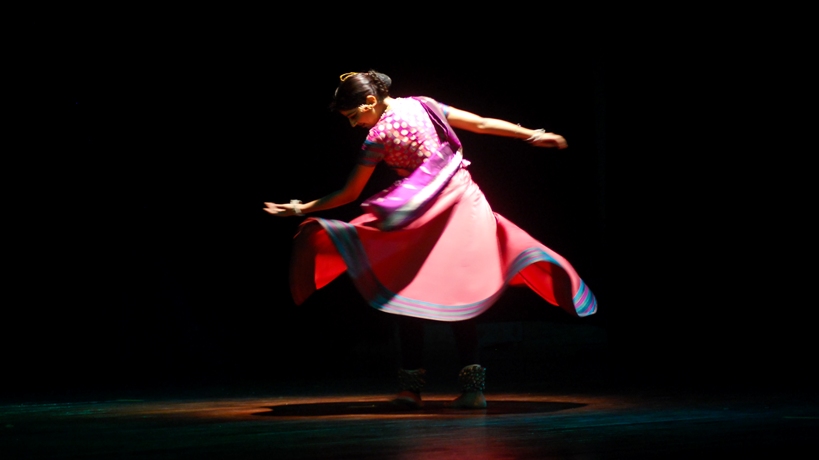
Kathak began to shift away from other traditional Indian dances, such as Bharatanatyam. The demi-plié stance of most other Indian dance forms gave way to straight legs taken from the Persian dancers. To emphasize the flamboyant and elaborate rhythmic footwork as many as 150 ankle bells on each leg were worn. It was also during this period that the signature ‘chakkars’ (spins) of Kathak were introduced, possibly influenced by the so-called whirling dervishes.
The straight-legged position gave a new vitality to the footwork, which wove percussive rhythms in its own right, whether together with or in complement to the tabla or pakhawaj. By this stage, the varied influences had introduced great flexibility into Kathak in terms of presentation and narrative dance. As Kathak moved away from the temples through folk dances to the court, it gathered many accretions of the themes on which the narrative dance could treat, resulting in a broader catchment of material for abhinaya pieces, and a less stylised and slightly informal presentation style which often incorporated improvisation and suggestions from the courtly audience.
The fusion of cultures developed Kathak in a singular manner, but although it was by now substantially different from the other Indian dance forms, the roots of the style remained the same, and as such it still displays a consanguineity with the others, particularly in the hand-formations during story-telling, and some of the body-postures, for example the tribhangi position, which is common to most Indian dance forms.
Later court influences – Many emperors and princely rulers contributed to the growth and development of Kathak into different gharanas, or schools of dance, named after the cities in which they developed. The Nawab of Oudh, Wajid Ali Shah, not only enjoyed giving patronage to dancers, but danced himself, taught by Durga Prasad. He himself choreographed a dance, Rahas, that he danced himself with the ladies of his court. He brought teachers to his palaces, aiding the expansion of technical vocabulary, and forming the basis of the Lucknow gharana, emphasizing sensuous, expressive emotion.
The Lucknow gharana placed emphasis on the abhinaya and natya elements or expressional qualities of the dancing; it was famed for its subtlety and grace (nazakat). This contrasted sharply with the Jaipur gharana, which became renowned for highly intricate and complex footwork, and fast, sharp, and accurate dancing. Royal courts in Rajasthan enjoyed Kathak as a sophisticated art form, fostering the growth of the Jaipur gharana. The Benares gharana was also created in this time.
During this period, Kathak was also extensively performed by tawaifs, who themselves developed the art in parallel to its refinement in court. They frequently performed abhinaya ( ‘the art of expression’) on lighter classical music of such as dadra, kajri and tappa as well as thumri. Given the tawaifs’ environment, their performance style of Kathak also differed from the court style, involving more of what in Kathak is termed nakhra (mischievous playfulness).
As the dance teachers of these tawaifs were also often the dance teachers of the court dancers, there was a fairly free interchange of ideas between the two milieus, and this helped consolidate the repertoire of Kathak. During the Raj (Native Nautch at Delhi, 1864) The advent of British Rule in India sent Kathak into sharp decline. The Victorian administrators publicly pronounced it a base and unlovely form of entertainment, despite often privately enjoying the pleasures of the tawaif. Indeed, by associating Kathak solely with the tawaifs and then associating the tawaifs with out-and-out prostitution, Kathak acquired an unwholesome image: the entirely British concept of nautch.
Famous tawaifs such as Gauhar Jan were instrumental in the maintenance and continuation of Kathak, even as it was officially denigrated by the prevailing political opinion. Kathak first received world’s attention in the early 20th century through Kalka Prasad Maharaj, whose sons Acchan, Lacchhu and Shambhu Maharaj, went on carry forward the tradition for the next generation, both as dancers in their own right and later as dance gurus.
Today, Kathak has regained its popularity after the period of decline during the rule of the British Empire (where it was frowned upon by Victorian administrators), and it is now one of the eight officially sanctioned classical dance forms of India. Kathak’s current form is a synthesis of all the input it has had in the past: court and romantic aspects sit comfortably side-by-side with the temple and mythological/religious.
Different dancers have worked on the form in different ways. The work of the Maharaj family of dancers (Acchan Maharaj, Shambhu Maharaj, Lachhu Maharaj and one of the great current dancers still alive today, Birju Maharaj) has been very successful in spreading the popularity of Kathak. Another disciple of Acchan Maharaj is Sitara Devi, daughter of Sukhdev Maharaj of Banaras. Her lively, zestful and fiery performances have impressed many audiences.
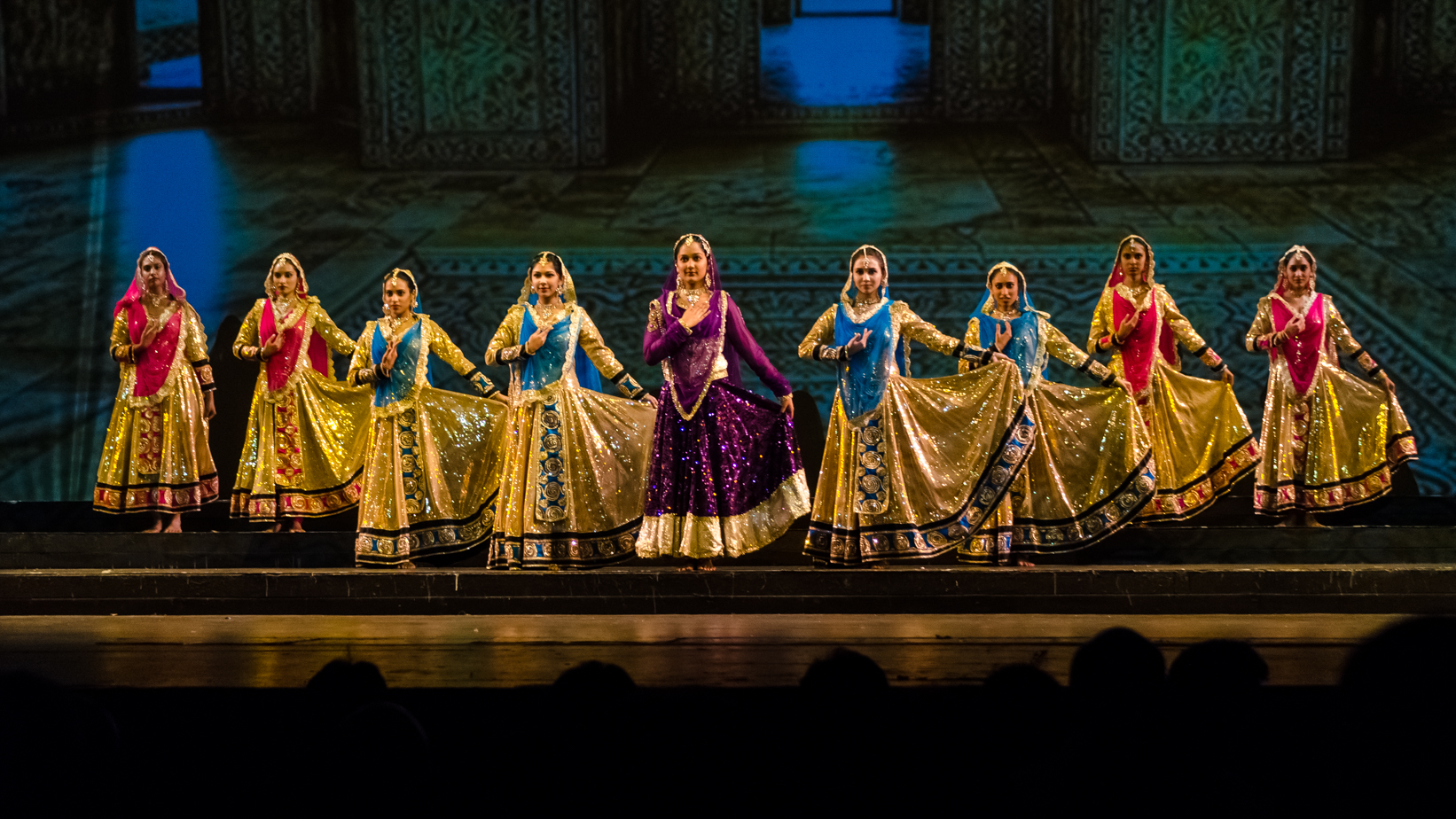
Shambhu Maharaj also trained Smt. Kumudini Lakhia, who, along with Birju Maharaj, has introduced the relative innovation of multi-person choreographies in Kathak, which was traditionally a solo dance form. She has gained a strong reputation for combining purely classical movements and style with distinctly contemporary use of space. The late Rohini Bhate greatly enriched Kathak’s rhythmic repertoire by creating a large corpus of dance compositions, while Durga Lal of the Jaipur gharana was famed for his speed and easy style of performance.
If you enjoyed reading this feature on the History – join us as we discuss the concept of Gharana in Kathak!
 Nateshwar Dance Academy