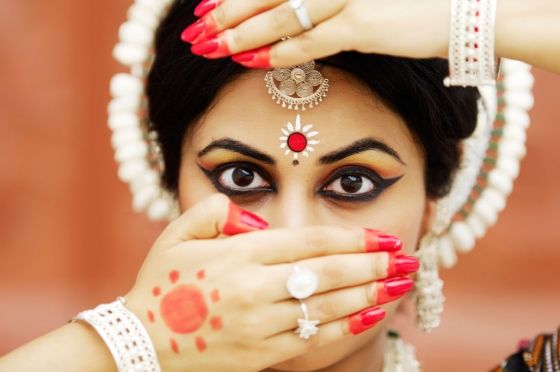

In this article we explore the history & traditions of Odissi. Odissi (Orissi) dance is an Indian classical dance from the Eastern state of Odissa. It has a long, yet broken tradition. Although dance in Odissa may be traced back more than 2000 years, it was brought to near extinction during the colonial period. Therefore, modern Odissi dance is a reconstruction.
The History of Odissi
Odissi can be traced back to its origin as secular dance. Later it got attached with the temple culture of Odisha. Starting with the rituals of Jagannath temple in Puri it was regularly performed in Shaivite, Vaishnavite and Sakta temples in Odisha. An inscription is found where it was engraved that a Devadasi Karpursri’s attachment to Buddhist monastery, where she was performing along with her mother and grandmother. It proves that Odissi first originated as a court dance. Later, it was performed in all religious places of Jainism as well as Buddhist monasteries. Odissi was initially performed in the temples as a religious offering by the Maharis who dedicated their lives in the services of God. It has the closest resemblance with sculptures of the Indian temples. The history of Odissi dance has been traced to an early sculptures found in the Ranigumpha caves at Udaygiri (Odisha), dating to the 2nd century BCE. Odissi appears to be the oldest classical dance rooted in rituals and tradition.
The Schools of Odissi
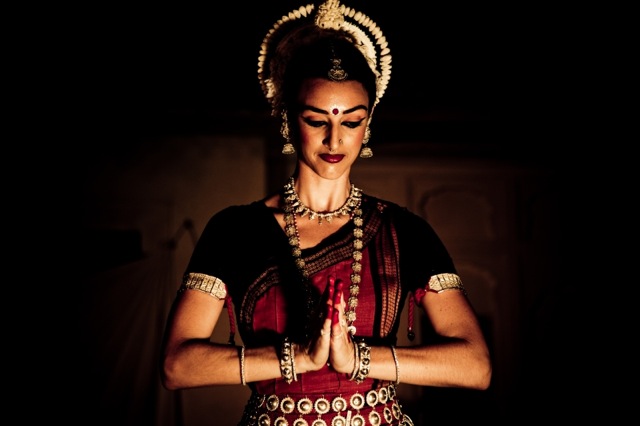
The Odissi tradition existed in three schools namely Mahari, Nartaki, and Gotipua.
Maharis were Oriya devadasis or temple girls, their name deriving from Maha (great) and Nari or Mahri (chosen) particularly those at the temple of Jagganath at Puri. Early Maharis performed mainly Nritta (pure dance) and Abhinaya (interpretation of poetry) based on Mantras and Slokas. Later, Maharis especially performed dance sequences based on the lyrics of Jayadev’s Gita Govinda. Bhitari Gauni Maharis were allowed in the inner temple while Bahari Gauni Maharis, though in the temples, were excluded from the sanctum sanctorum.
By the 6th century, the Gotipua tradition was emerging. One of the reasons given for the emergence of Gotipuas is that Vaishnavas did not approve of dancing by women. Gotipuas were boys dressed up as girls and taught the dance by the Maharis. During this period, Vaishnava poets composed innumerable lyrics in Oriya dedicated to Radha and Krishna. Gotipuas danced to these compositions and gradually stepped out of the precincts of the temples.
Nartaki dance took place in the royal courts, where it was much cultivated before the British period. At that time the misuse of devadasis came under strong attack, so that Odissi dance withered in the temples and became unfashionable at court. Only the remnants of the Gotipua school remained, and the reconstruction of the style required an archaeological and anthropological effort that has tended to foster a conservative purism.

Odissi Dance vocabulary and repertoire
The traditional Odissi repertoire consists of:
Mangalacharana
An invocation piece. After paying homage to Lord Jagannath a shloka (hymn) in praise of some God or Goddess is sung, the meaning of which is brought out through dance. Mangalacharan also includes the Bhumi Pranam (salutation to Mother Earth) which is offered to Mother Earth as a way of begging forgiveness for stamping on her and the Trikhandi Pranam or the three-fold salutation – above the head to the Gods, in front of the face to the gurus and in front of the chest to the audience.
Battu Nrutya
Also known as Sthayee Nrutya or Batuka Bhairava (Furious Dance) it is performed in the honor of Lord Shiva- the cosmic Lord of Dance. It is one of the 64 furious-aspects of Lord Shiva known. The origin of dance is believed to be from Tantrism that had flourished in Odisha.
Linga Purana and Mahanirvanatantra give an elaborate description of Batuka Bhairava in three aspects, and the results of their worship have also been explained elaborately in the texts. Battu Nrutya is an item of pure Nrutya (Dance)and remains the most difficult item of Odissi dance. The dance begins with a series of sculpturesque poses depicting such actions as the playing of a Veena (Lute), Mardala or Pakhawaj (Drum), Karatala (Cymbals) and Venu (Flute), that brings out the interrelationships between this dance and the dance sculptures adorning the temples of Odisha.
These poses are stringed together with steps in different rhythms. There is no song or recitation accompanying the dance, but throughout the item a refrain of rhythmic syllables is provided. The accompanying refrain is in the form of one line of Ukuta and as this is recited in the Tala, different Jathi-patterns are improvised and are executed with the feet. Some Tala variations are introduced and each sequence of the dance terminates with a Tehdi known as Katam. The last sequence is always in Jhula Pahapata Tala and is performed with a fast tempo.
Pallavi
A pure dance item in which a raga is elaborated through eye movements, body postures & intricate footwork. Pallavi literally means “blossoming”. This is applicable not only to the dance, but also to the music, which accompanies it. Pallavi starts with slow, graceful & lyrical movements of the eyes, neck, torso & feet & slowly builds in a crescendo to climax in a fast tempo at the end. Both the dance and the music evolve in complexity as the dancer traces multiple patterns in space, interpreting the music dexterously in the multilayered dimensions of taal (rhythm) and laya (speed).
Abhinaya
An expressional dance which is an enactment of a song or poetry, where a story conveyed to the audience through mudras (hand gestures), bhavas (facial expression), eye movement and body movement. The dance is fluid, very graceful, and sensual. Abhinaya can be performed on verses in Sanskrit or Oriya language. The verses are extremely ornate in content and suggestion. Most common are Abhinayas on Oriya songs or Sanskrit Ashthapadis or Sanskrit stutis like Dasavatar Stotram (depicting the ten incarnations of Lord Vishnu) or Ardhanari Stotram. Most of the Abhinaya compositions are based on the Radha-Krishna theme. The Astapadis of the kãvya Gita Govinda written by the Saint Jayadev are an integral part of its repertoire. The beginning pieces are dedicated to Lord Jagannath – an incarnation of Lord Vishnu.
Dance drama
Usually longer than Abhinaya and typically performed by more than one dancers. Usually Hindu mythologies are chosen as themes, but experimenting with the theme and form in recent years have led to extremely unique creations. Some worth-mentioning themes in recent years are Panchakanya, Ganga Yamuna, Chitrangadaa, Shrita Kamalam, Mrutyuh, Tantra, Padapallavam, and Raavana.
Moksha
The concluding item of a recital. Moksha means “spiritual liberation”. This dance represents a spiritual culmination for the dancer who soars into the realm of pure aesthetic delight. Movement and pose merge to create ever new patterns, ever new designs in space and time. The dance moves onto a crescendo that is thrilling to both, the eye and the ear. With the cosmic sound of the “Om”, the dance dissolves into nothingness — just like Moksha or the deliverance of the soul in real life.

Odissi music
Odissi music has codified grammars, which are presented with specific Raagas. It has also a distinctive rendition style. It is lyrical in its movement with wave-like ornamentation. The pace of singing in Odissi is not very fast nor too slow, and it maintains a proportional tempo which is very soothing.
Costume & Jewellery of Odissi
The jewellery is made from intricate filigree silver pieces. Filigree- means “thin wire”, and in Oriya it is called Tarakasi. This highly skilled art form is more than 500 years old and is traditionally done by local artisans on the eastern shores of Odisha. The process of creating each piece takes the collaboration of many artisans each specialised in one step of the many that turns a lump of raw silver into a handcrafted work of art.
The jewellery pieces are an important part of the female Odissi dancer’s costume. The hair is drawn into an elaborate bun on which the Tahiya is placed. The Seenthi is a jewellery piece placed on the hair and forehead. The dancers face is adorned with Tikka (decorations made by hand with sandalwood paste), Mathami or Matha Patti (forehead ornament), Allaka (head piece on which the tikka hangs), unique ear covers called Kapa in intricate shapes usually depicting a peacock’s feathers, an ear chain, Jhumkas (bell shaped earrings), a short necklace, and a longer necklace with a hanging pendant.
The dancer wears a pair of armlets also called Bahichudi or Bajuband, that is worn on the upper arm. They wear a pair of Kankana (bangles) at the wrist. At the waist they wear an elaborate belt made of silver or similar materials that’s silver plated. They wear a pair of ankle bells (numerous small bells strung together on a single string) tied around their ankles. The dancer’s palms and soles are painted with red coloured dye called the Alta.
The crown or Mukoot or Mookut, worn by the Odissi dancer is made only in the devotional city of Puri in Eastern Odisha. It is formed from the dried reeds called Sola in a tradition called Sola Kama. The reed is carved by a series of cuts into the rod-like stem and forms various types of flowers when a string is tied in the middle of the rod and pulled tight. As the string is tightened, the flowers shape into Jasmines, Champa (one of the five flowers of Lord Krishna’s arrows), and Kadamba (the flowers of the tree under which Radha would wait for her beloved Lord Krishna).
The Mukoot consists of two parts i.e. Ghoba and Tahiya. The flower decorated back piece, called the Ghoba, sits around the dancer’s hair pulled into a bun at the back of the head. This piece represents the Lotus flower with a thousand petals that lies above the head in the head Chakra, or energy center. The longer piece that emerges from the center of the back piece is called the Tahiya, and this represents the temple spire of Lord Jagannath or the flute of Lord Krishna.
The Saree worn by Odissi dancers are generally coloured with bright shades of orange, purple, red or green. These sarees are characterised by features of traditional prints of Odisha, special borders, intricate designs and a shiny embellishment. This costume is drapped around the body in unique traditional way unlike other classical dance forms of India. Sambalpuri Saree and Bomkai Saree are preferred in Odissi dance over other type of Sarees. “Stitched costumes” are popular with the younger generation for its convenience and is composed of five pieces, that includes angrakha, blouse, pyjama, etc. These costumes are created by making use of the Sambalpuri and Bomkai saree materials.
The makeup of an Odissi dancer includes Bindi (red dot), applied on the forehead with a pattern made from sandalwood around it, Kajal (black eyeliner), applied around the eyes with a broad outline to give them an elongated look, among others.

Odissi Terminology
- Alap- It is the opening section of a typical Indian classical performance. It is unmetered, improvised (within the raga) and unaccompanied (except for the drone of the tanpura), and is started at a slow tempo
- Anadha – Hide category of the 4 musical divisions, e.g. Mardala or Pakhawaj (Drum), Tabla, and Mridangam.
- Asanjukta Dhvanis – Sound created by striking the Mardala or Pakhawaj (Drum) with one hand.
- Avartan – One complete cycle of a taal.
- Bani – The spoken drum mnemonics. During dance performances Banis are spoken by the percussionist or the guru.
- Bhaga – In taal, this would be the groups the taal is divided into. Also the points on which the tali, or khali would be e.g., Adital (Odissi) is divided into 4 groups of 4 beats. It is said that Adital has 4 Bhagas. These are the measures.
- Bhajan – It is any type of Indian devotional song and has no fixed form. It may be as simple as a Mantra or Kirtan or as sophisticated as the Dhrupad or Kriti with music based on classical Ragas and Talas. It is normally lyrical, expressing love for the Divine.
- Chanda – In taal, this would be how the divisions of the taal are made e.g. in Adital (Odissi), the sixteen beats are divided into 4 groups of 4.
- Devadasis – They were the original temple dancers who were “Servitress of God”. They were dedicated to a deity or a temple. Apart from taking care of the temple and performing various rituals, these women learned and practiced Odissi dance, for dance and music were an essential part of temple worship. They enjoyed a high social status.
- Gita Govinda Poet Jayadev’s famous work depicting the relationship of Radha, Krishna and Gopis in Vrindavan. Themes from this work have a great significance towards the classical arts of India.
- Goti – These are barrel-shaped tension pegs made of wood which adorn the Mardala or Pakhawaj (Drum). The straps (Pitha) connecting the two apertures of the Mardala run over them. These pegs can be moved to either increase or decrease the tension of the leather membranes covering the two apertures of the Mardala and are useful in tuning it.
- Gotipua – Young boys trained in the fine art of Odissi dance. The Gotipuas were allowed to leave the temple and dance for the public. The current form of Odissi is heavily influenced by the Gotipua tradition (and also the temple carvings from Odisha.)
- Mana – The ending sequence that is repeated to designate that the ending of the piece or of a section that is typically in 3 repeats. People in Odisha interchangeably use Tihai and Mana, but they are the same.
- Maharis or Devadasis – The original temple dancers of Odisha, but now extinct. This is the root of Odissi dance that was later taught to young boys, Gotipuas. The style is now modernized and work is being done to preserve it.
Thank you for reading our feature on Odissi – Watch the superbly talented Sujata Mohapatra perform Odissi in the five-part feature below:
Feature 1
Feature 2
Feature 3
Feature 4
Feature 5
 Nateshwar Dance Academy