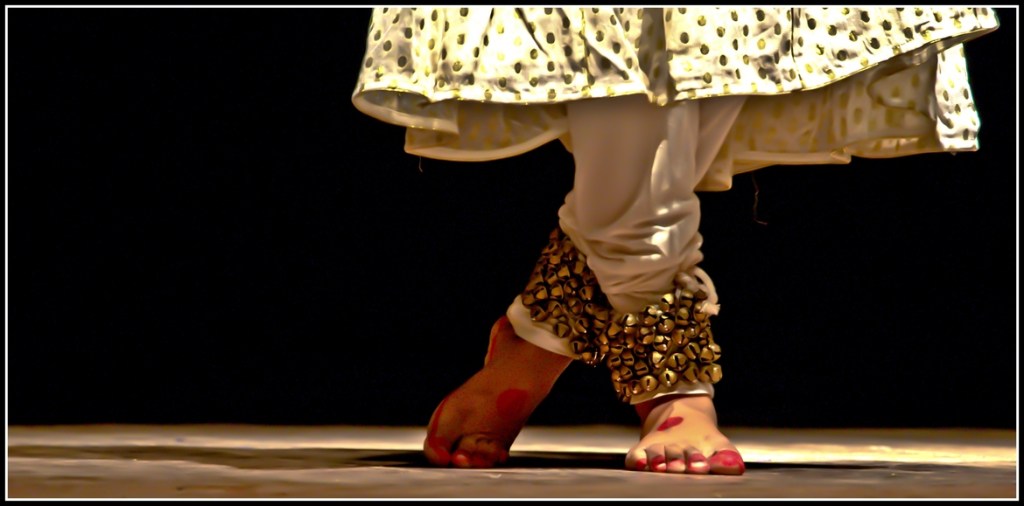
Nritta (Pure Dance)
The structure of a conventional kathak performance tends to follow a progression in tempo from slow to fast, ending with a dramatic climax. A short dance composition is known as a tukra, a longer one as a toda. There are also compositions consisting solely of footwork known as tihais or laris. Often the performer will engage in rhythmic play with the time-cycle, for example splitting it into triplets or quintuplets which will be marked out on the footwork, so that it is in counterpoint to the rhythm on the percussion. This is known as layakari.
All compositions are performed so that the final step and beat of the composition lands on the ‘sam’ (pronounced as the English word ‘sum’ and meaning even or equal, archaically meaning nil) or first beat of the time-cycle with a dramatic flourish. Most compositions also have ‘bols’ (rhythmic words) which serve both as mnemonics to the composition and whose recitation also forms an integral part of the performance. This recitation is known as padhant. Some compositions are aurally very interesting when presented this way. The bols can be borrowed from tabla.
Often tukras are composed to highlight specific aspects of the dance. A popular tukra type is the chakkarwala tukra, showcasing the signature spins of Kathak. Because they are generally executed on the heel, these differ from ballet’s pirouettes (which are properly executed on the toe or ball of the foot). The spins usually manifest themselves at the end of the tukra, often in large numbers: five, nine, fifteen, or more, sequential spins are common. These tukras are popular with audiences because they are visually exciting and are executed at great speed. Other compositions can be further particularised as follows:
- Vandana – the dancer begins with an invocation to the divinity. Vandana means prayer, a dance item which is performed as prayer. Before Mughal influence kathak was mostly performed in temple and the form was totally devoted to God. So in those times vandana was too important and it reserved a large part of dance. These days performances generally have Vishnu or Ganesh Vandana, invocation of Ganesha, the Hindu god of beginnings and good fortune.
- Thaat, the first composition of a traditional performance; It is the style of standing. The dancer performs short plays with the time-cycle, finishing on sam in a statuesque standing (thaat) pose.
- Aamad, from the Persian word meaning ‘entry’; the first introduction of spoken rhythmic pattern or bol into the performance.
- Salaami, related to Ar. ‘salaam’ – a salutation to the audience in the Muslim style.
- Kavitt, a poem set on a time-cycle; the dancer will perform movements that echo the meaning of the poem.
- Paran, a composition using bols from the pakhawaj instead of only dance or tabla bols.
- Parmelu or Primalu, a composition using bols reminiscent of sounds from nature, such as kukuthere (birds), jhijhikita (sound of ghunghru), tigdadigdig (strut of peacock) etc.
- Gat, from the word for ‘gait’ (walk) showing abstract visually beautiful gaits or scenes from daily life.
- Lari, a footwork composition consisting of variations on a theme, and ending in a Tihai.
- Tihai, usually a footwork composition consisting of a long set of bols repeated thrice so that the very last bol ends dramatically on ‘sam’.
- Toda, a dancer performs to the composition of time beats in a rhythmic cycle, ending with Tehai and arriving on the ‘sam’, a concluding beat in a dramatic pose.
Here is a beautifully choreographed Ganesh Vandana performed by Meghranjani Medhi, as discussed above, the dancer begins with an invocation to the divinity. Vandana means prayer, a dance item which is performed as prayer. Before Mughal influence kathak was mostly performed in temple and the form was totally devoted to God.
Nritya (Expressive Dance)
Aside from the traditional expressive or abhinaya pieces performed to a bhajan, ghazal or thumri, Kathak also possesses a particular performance style of expressional pieces called bhaav bataanaa (lit. ‘to show bhaav or ‘feeling’). It is a mode where abhinaya dominates, and arose in the Mughal court.
It is more suited to the mehfil or the darbaar environment, because of the proximity of the performer to the audience, who can more easily see the nuances of the dancer’s facial expression. Consequently, it translates to the modern proscenium stage with difficulty.
A thumri is sung, and once the mood is set, a line from the thumri is interpreted with facial abhinaya and hand movements while seated. This continues for an indefinite period, limited only by the dancer’s interpretative abilities. For example, Shambhu Maharaj is claimed to have interpreted a single line in many different ways for hours. All the Maharaj family (Acchan Maharaj, Lachhu Maharaj, Shambhu Maharaj and Achhan Maharaj’s son Birju Maharaj) have found much fame for the naturalness and inventiveness of their abhinaya.
 Nateshwar Dance Academy